Escrevivendo e Photoandarilhando por ali e por aqui

“O que a fotografia reproduz no infinito aconteceu apenas uma vez: ela repete mecanicamente o que não poderá nunca mais se repetir existencialmente”.(Roland Barthes)

«Todo o filme é uma construção irreal do real e isto tanto mais quanto mais "real" o cinema parecer. Por paradoxal que seja! Todo o filme, como toda a obra humana, tem significados vários, podendo ser objecto de várias leituras. O filme, como toda a realidade, não tem um único significado, antes vários, conforme quem o tenta compreender. Tal compreensão depende da experiência de cada um. É do concurso de várias experiências, das várias leituras (dum filme ou, mais amplamente, do real) que permite ter deles uma compreensão ou percepção, de serem (tendencialmente) tal qual são. (Victor Nogueira - excerto do Boletim do Núcleo Juvenil de Cinema de Évora, Janeiro 1973

sexta-feira, 1 de janeiro de 2010

Fuga para Fiji - O artista e o surf

Fuga para Fiji
O artista e o surf
Por Marcelo Lacerda em 31/12/09 01:08 GMT-03:00
146169
Tavarua, Fiji. Foto: Ricardo Serpa.
esquerda
Tavarua, Fiji. Foto: Ricardo Serpa. Tavarua, Fiji. Foto: Ricardo Serpa. Tavarua, Fiji. Foto: Ricardo Serpa. Tavarua, Fiji. Foto: Ricardo Serpa. Tavarua, Fiji. Foto: Ricardo Serpa. Tavarua, Fiji. Foto: Ricardo Serpa. Adrian Kojin, Tavarua, Fiji. Foto: Ricardo Serpa. Alex Miranda, Tavarua, Fiji. Foto: Ricardo Serpa. Alex Miranda, Tavarua, Fiji. Foto: Ricardo Serpa. Alex Miranda, Tavarua, Fiji. Foto: Ricardo Serpa. Alex Miranda, Tavarua, Fiji. Foto: Ricardo Serpa. André Neuding, Tavarua, Fiji. Foto: Ricardo Serpa. André Neuding, Tavarua, Fiji. Foto: Ricardo Serpa. Carlos "Califa" Sarli, Tavarua, Fiji. Foto: Ricardo Serpa. Carlos Lisboa, Tavarua, Fiji. Foto: Ricardo Serpa. Dylan, Tavarua, Fiji. Foto: Ricardo Serpa. Fábio Simões, Tavarua, Fiji. Foto: Ricardo Serpa. Fábio Simões, Tavarua, Fiji. Foto: Ricardo Serpa. Gui Mattos, Tavarua, Fiji. Foto: Ricardo Serpa. Ingo Wender, Tavarua, Fiji. Foto: Ricardo Serpa. Japa, Tavarua, Fiji. Foto: Ricardo Serpa. Japa, Tavarua, Fiji. Foto: Ricardo Serpa. Jimmy, Tavarua, Fiji. Foto: Ricardo Serpa. Kalani Brito, Tavarua, Fiji. Foto: Ricardo Serpa. Kalani Brito, Tavarua, Fiji. Foto: Ricardo Serpa. Marcello Serpa, Tavarua, Fiji. Foto: Ricardo Serpa. Marcelo Lacerda, Tavarua, Fiji. Foto: Ricardo Serpa. Marcos Brandão, Tavarua, Fiji. Foto: Ricardo Serpa. Marcos Brandão, Tavarua, Fiji. Foto: Ricardo Serpa. Marcos Brandão, Tavarua, Fiji. Foto: Ricardo Serpa. Mickey Bernardoni, Tavarua, Fiji. Foto: Ricardo Serpa. Mickey Bernardoni, Tavarua, Fiji. Foto: Ricardo Serpa. Oskar Metzavat, Tavarua, Fiji. Foto: Ricardo Serpa. Paulo Vainer, Tavarua, Fiji. Foto: Ricardo Serpa. Paulo Vainer, Tavarua, Fiji. Foto: Ricardo Serpa. Prince, Tavarua, Fiji. Foto: Ricardo Serpa. Rafael Mellin, Tavarua, Fiji. Foto: Ricardo Serpa. Rafael Mellin, Tavarua, Fiji. Foto: Ricardo Serpa. Rafael Mellin, Tavarua, Fiji. Foto: Ricardo Serpa. Rafael Mellin, Tavarua, Fiji. Foto: Ricardo Serpa. Ricardo Rittes, Tavarua, Fiji. Foto: Ricardo Serpa. Ricardo Rittes, Tavarua, Fiji. Foto: Ricardo Serpa. Roberto Severo, Tavarua, Fiji. Foto: Ricardo Serpa. Rubens Simões, Tavarua, Fiji. Foto: Ricardo Serpa. Rubens Simões, Tavarua, Fiji. Foto: Ricardo Serpa. Rubens Simões, Tavarua, Fiji. Foto: Ricardo Serpa. Sandro Bassili, Tavarua, Fiji. Foto: Ricardo Serpa. Sandro Bassili, Tavarua, Fiji. Foto: Ricardo Serpa. Sylvio de Barros, Tavarua, Fiji. Foto: Ricardo Serpa. Sylvio de Barros, Tavarua, Fiji. Foto: Ricardo Serpa. Tayguara Helou, Tavarua, Fiji. Foto: Ricardo Serpa. Tavarua, Fiji. Foto: Ricardo Serpa. Tavarua, Fiji. Foto: Ricardo Serpa. Tavarua, Fiji. Foto: Ricardo Serpa.
Na terceira semana de novembro um grupo de brasileiros ocupou com exclusividade a ilha de Tavarua, no arquipélago de Fiji, ao Sul do Pacífico. A previsão era de boas ondas, na medida para uma semana de surfe e relax.
.
Tavarua é hoje um endereço bem conhecido do surfe mundial, com esquerdas perfeitas em Restaurants, o pico da ilha, e em Cloudbreak, um reef no meio do mar com formação longa e tubular, também para a esquerda.
.
Entre os mais de vinte brasileiros havia surfistas excelentes, em técnica e estilo, alguns acostumados com ondas grandes. O grupo era comandado pelo famoso Vavá (Váva, em Fijiano), da Nivana Turismo, uma carismática liderança do surfe brasileiro. Esposas e namoradas traziam um colorido especial para o mar turquesa e noites estreladas. Dois profissionais da imagem, Kalani Brito – fotógrafo da Fluir, e Mickey Bernardoni, da nova geração de videomakers do esporte, registraram imagens memoráveis daqueles dias de ondas perfeitas.
.
Tudo dentro do figurino para uma inesquecível viagem de surfe, a não ser por um fator especial: a presença de Ricardo Serpa. Ricardo é um destes artistas da imagem, alguém cuja câmera capta aquele detalhe que pode não ser percebido a olho nú. Nos anos 90 abandonou uma vida de executivo e saiu para garimpar luz e sombra. Por algum tempo fez fotojornalismo no Jornal do Brasil. Depois, voou para outras terras.
.
Na era dos pixels, que dispensa revelação, revelar imagens expressa com fidelidade o trabalho de Ricardo. Ele capta detalhes do movimento mesclado com emoção. A luminosidade do mar e o movimento se misturam de forma harmônica, e os atores parecem pertencer àquele cenário de sonho. No surfe muitas vezes a surpresa se transforma em susto (algo não improvável em um mar com mais de 3 metros). Algumas cenas do Ricardo expressam esse instante, estampado na face do surfista.
.
Além disso é legal conviver com este gentil carioca de bom humor e perceber que é possível abrir mão de algum caminho pré-determinado, para seguir uma trilha mais próxima da arte e expressar algo que precisava ter vazão.  Atualmente Ricardo mora na Flórida com a Nicole e quatro filhotes, e tem se dedicado a desvendar imagens em momentos preciosos para famílias americanas e brasileiras.
.
Uma vez o Sidão (Tenucci), um dos mestres surfistas brasileiros, me disse que o surfe é um retorno ao momento presente. De alguma forma, e com simplicidade, o trabalho de Ricardo congela estes momentos e os estende no tempo.
.
Na galeria de fotos acima, você confere os melhores momentos desta surf trip para Tavarua. A propósito, o surfe foi épico! Mas isto é outra história...
.
Clique aqui para ver algumas imagens clicadas por Ricardo Serpa ao longo de sua carreira no fotojornalismo.


Resolução Mínima de 1024x768 © Copyright 2008, Terra Networks S.A. -
.
.

Rodchenko: The impact of revolution and counterrevolution

By Paul Mitchell
WSWS - 10 April 2008
“Alexander Rodchenko: Revolution in Photography” at the Hayward Gallery, London, until April 27
.

The current exhibition of photomontages and photographs by Alexander Rodchenko (1891-1956) at London’s Hayward Gallery is one of the most comprehensive retrospectives of his work ever held. Rodchenko’s life is a powerful reminder of the creative energy unleashed by the Russian Revolution of 1917 and how it was strangled by the Stalinist counter-revolution.
.
Rodchenko pioneered the use of photomontage in post-revolutionary Russia for book and magazine covers, posters and advertisements—working closely with the poet Vladimir Mayakovsky, who provided the literary input. The partnership became extremely successful with Rodchenko writing in his diary, “We had completely conquered Moscow and completely shifted, or rather, changed the old, tsarist-bourgeois-Western style of advertising for the new Soviet.”
.
The first room of the exhibition displays contain fine examples of these works including the haunting cover for Mayakovsky’s 1923 love poem About That and the striking film poster for Cine-Eye
.

In 1924, Rodchenko took up photography and was soon capturing a person’s character or a particular event in a new and unique way. The second room of the Hayward Gallery has many of these early pictures, which have become iconic images in the history of photography, including the intimate 1924 photograph Mother and the portraits of his friends and comrades in the “Left Front of the Arts” (LEF) such as Mayakovsky and Osip Brik, made all the more poignant by the fact they all, in one way or another, became victims of Stalin’s terror.
.
LEF, said Rodchenko, “as the avant-garde of Communist culture is obligated to show how and what needs to be photographed. What to shoot—is something every photo group knows but how to shoot—only a few know.”
.
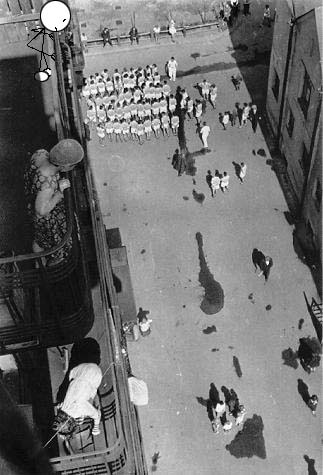
For Rodchenko, “how to shoot” increasingly meant taking his photographs from unusual perspectives and angles—“from the top down,” the “bottom up” and “their diagonals.” He later explained how, in 1925 in Paris, “when I first saw the Eiffel Tower from afar. I didn’t like it at all. But once I was passing nearby on a bus, and when I saw the lines of the metal diminishing upwards, from right and left through the window, this perspective gave me the impression of the mass and the construction, which ‘from the navel’ creates only a gentle spot, the one we’re so sick of on all those postcards.” Several photos taken in the neighbourhood of Rodchenko’s small apartment in Moscow, including Fire Escape with a Man (1925) and Assembling for a demonstration (1928-1930), still demonstrate the thought-provoking manner of this way of taking photographs.
.
Rodchenko’s preoccupation with unusual perspectives and angles was derived from conceptions he began to develop in his youth. Prior to the revolution, Rodchenko attended art school in Kazan, where he met his lifelong companion, Varvara Stepanova (1894-1958), and joined the Futurist movement led by Mayakovsky, David Burliuk and Vasily Kamensky. He then moved to Moscow and took up painting, working alongside leading artists such as the Constructivist Vladimir Tatlin.
.
Rodchenko, who was one of the few Russian artists to identify fully with the new revolutionary government, became a leading proponent of Constructivism at the Moscow-based Higher Technical-Artistic Studios (VKhUTEMAS), where he taught from 1920 to 1930. He rejected “pure” art, saying it should be used for social purposes and the furtherance of the revolution. In 1921, he and Stepanova wrote the Productionist Manifesto, which declared the artist’s task was to “direct materialist, constructivist work towards communist ends.” Its slogans included, “Down with art, long live technical science” and “Destroy the last remaining attachment of human thought to art.”
.
In many ways, these conceptions mirrored those put forward by the supporters of “Proletarian Culture” (Proletcult), who were to form the core of the All-Russian Association of Proletarian Artists (VAPP) and who led the attacks on Rodchenko and LEF in 1928.
.
Both trends were criticised by Leon Trotsky who warned, “To reject art as a means of picturing and imaging knowledge because of one’s opposition to the contemplative and impressionistic bourgeois art of the last few decades, is to strike from the hands of the class which is building a new society its most important weapon.” He rejected the possibility of forming “proletarian art,” explaining that by the time the working class had had time to create a new culture, the conditions for the transformation to a classless society would already have developed. The new culture would be non-class and express universal human values of solidarity and equality.
.
Trotsky’s comrade, the literary critic Alexander Voronsky, warned the members of LEF that seeing art as “constructing” life rather than “cognising” it was a utopian conception that would make its adherents “slide into complete subjectivism” and end up seeing everyday life as only “banality, tradition and inertia.”
.
The exile of Trotsky in 1928 and the repression of the Left Opposition he led were accompanied by an assault on all forms of critical thought by the victorious Stalinist bureaucracy. Rodchenko was accused of “bourgeois formalism”—i.e. producing elitist art, which the masses could not understand. Particular venom was directed at his Pioneers (1928-1930) series of photographs, with one critic declaring, “The Pioneer Girl has no right to look upward. That has no ideological content. Pioneer girls and Komsomol girls should look forward.”
.
The magazine Soviet Photo accused him of plagiarising Western photographers. He tried to fight back, writing in New LEF magazine that it was “not just some stupid smear.... It’s a kind of projectile missile attacking new photography. Its goal in discrediting me is to scare photographers involved in new points [of view].”
.
He added, “There’s no revolution in the fact that instead of a portrait of a general, people have started photographing the workers’ leaders with the same photographic approach as under the old regime or under the influence of the artistic West.”
.
However, the constant attacks on Rodchenko made him begin “to think in incredibly gloomy terms,” and he even contemplated suicide. “What’s happening?” he wrote in his diary. “I support the Soviet power heart and soul, I work for it with belief and love and all my strength and suddenly we are wrong.”
.
To make matters much worse, Mayakovsky “abandoned” LEF and joined VAPP. Rodchenko explained, “Of course we understood that he would fight in all sorts of ways for us to join too, but, on the other hand, we knew that VAPP had torn Mayakovsky away from us—not in order to give him a broad creative expanse, and not so that all the Lefists would join VAPP, but for precisely the opposite reasons. We knew that there would be nothing for us to do in VAPP, nor for Mayakovsky either.”
.
“And that’s how it turned out.”
.
Rodchenko continued to help Mayakovsky with his retrospective show “Twenty Years of Work,” but the lack of interest shown by the press and VAPP leaders “poured oil on the fire of Mayakovsky’s feelings of loneliness.” On April 14, 1930, the poet, who had joined the Bolshevik party in 1908 at the age of 16, committed suicide.
.
In the same year, VKhUTEMAS was closed, and in the following year, the October group Rodchenko founded with the photographer Boris Ignatovich was also shut down.
.
By early 1933, Stalin’s policies had helped deliver the German working class into the hands of the Nazis and brought about the downfall of the Communist International as a revolutionary instrument. From 1934, the bureaucracy ruthlessly imposed its anti-artistic and anti-Marxist doctrine of “socialist realism,” sealing the fate of creative cultural life.
.
Rodchenko was not spared. He was forbidden to photograph independently and only allowed to cover military parades, sporting events (Diving) and the circus (The Rhine Wheel). His unique way of seeing the world still shines through.
.
Rodchenko was commissioned to carry out several photo-reportage projects for magazines such as USSR Under Construction, but they can only be described as propaganda exercises for the regime. One of the most infamous was the book Belomor-Baltic Canal Named After Stalin, which documents the construction of the 140-mile-long waterway in 500 gruelling days by political prisoners and convicts. An imprint of Stalin’s face adorns the front cover whilst inside are sanitised photographs such as Workers Orchestra where weary workers labour away in the depth of a lock whilst an orchestra plays above.
.
Rodchenko still manages to produce one of the most poignant pictures in the exhibition, Girl with a Leica 1934, which depicts his assistant, Evgenia Lemberg. Hidden by the half-light and meshwork enveloping her like a cage, the young woman whom Rodchenko had fallen in love with was to die shortly afterwards in a railway accident.
.
In 1935 the “Masters of Soviet Art” exhibition was held, but Rodchenko was only allowed to display his works on condition that he publicly denounce his “formalist” errors. To rub salt into the wound, his confession was printed in Soviet Photo, the magazine that had led the witch-hunt against him. It is terrible to see him write how he was “struck by the sensitivity and wisdom with which the re-education of people was conducted” during the building of the Baltic Canal before declaring, “Henceforth I want to decisively reject putting formal solutions to a theme in the first place and ideological ones in second place; and at the same time I want to search inquisitively for new riches in the language of photography, in order, with its help, to create works that will stand on a high political and artistic level, works in which the photographic language will fully serve Socialist Realism.”
.
Once Rodchenko made his confession, he was virtually ignored. He was plagued by poverty, hunger and ill health, and the threat of further political attacks hung over him. In 1940, Rodchenko wrote despairingly in his diary, “I think I have lived my life fairly pointlessly and without much calculation, and approaching old age I’ve turned out to be an eccentric, not needed by anyone and not interesting to anyone. I don’t expect anything, I hope for nothing.”
In 1942, Rodchenko stopped photographing and decided to start painting again. It seems to have re-invigorated him. On July 30, 1943, he wrote in his diary:
.
“The painting has taken off!! But horrors!!! It’s leftist painting. And Lord Almighty, what a joy it is to be leftist.... To be myself after all these torments and counter to common sense. Not to break myself, to paint with pleasure!! What will be, will be!!! But I’ll die leftist and leave behind good works.”
.
At one point he writes mockingly, “Stalin—is a hero of Socialist Labour and marshal of the Soviet Union and Supreme Commander!” but concludes, “I’m a romantic. It seems that everything could have been done differently. Both the life of the USSR and myself....”
.
That last entry in Rodchenko’s diary is worth thinking about. It is in stark contrast to the conclusion reached by the exhibition’s curator, Olga Sviblova, that the Soviet government and the Russian avant-garde “danced together.” Both, she claims, believed “absolutely that they were working to change reality for the better, and that that change would arrive tomorrow. It was a big delusion, but they believed in it all the same.”
.
Sviblova’s statement is symptomatic of the main problem with the exhibition—its superficial treatment of the historical context of Rodchenko’s life and works. Nevertheless, she is to be congratulated for assembling such a comprehensive collection of pictures, and you should try and get along to see them.
.
About That
Cine-Eye
Mother
Mayakovsky
Osip Brik
Escape with a Man (1925)
Assembling for a demonstration (1928-1930)
Pioneers (1928-30)
Diving
http://desibilasypitias.files.wordpress.com/2007/08/rodchenko2.jpg
The Rhine Wheel
Workers Orchestra
Girl with a Leica 1934
.
See Also:
The forging of a new art: "New Art for a New Era: Malevich's Vision of the Russian Avant-Garde" At the Barbican Centre, London
[16 June 1999]
Rodchenko's art and fate: the experiment continues
[29 August 1998]
.
.

Resultados de imagens para Rodchenko

  .
.

Rodchenko, Alexander - Fotografia

O SÉCULO PRODIGIOSO

A arte no século XX

Rodchenko, Alexander - Fotografia


Rodchenko and Stepanova, 1922


Pro eto. Ei i mne by Vladimir Mayakovsky. 1923
Book with nine letterpress photomontages


Portrait of mother - 1924


Lily Brik - 1924


The poet Vladimir Mayakovsky - 1924


The Critic Osip Brik - 1924


Stepanova with a cigarette - 1924


Vladimir Mayakovsky, 1924


Balconies - 1925


Balconies. 1925


House on Myasnicka Street, 1925


Fire-escape, from the series “House on Myasnitskaya” - 1925


Back cover of the book Conversation with the Finance Inspector
about Poetry (Razgovor c fininspektorom o poesii), by Vladimir
Mayakovsky, 1926


Change of All - 1927


A Part of Moscow, 1927


On the telephone - 1928


Pioneer, 1928


Gathering for the demonstration in the courtyard of the VChUTEMAS
(Higher Institute of Technics and Art) - 1928


To the demonstration - 1928


Pioneer - 1930


Stairway, 1930


Untitled photograph from a series on a lumber mill in Vakhtan. 1930


Lefortovo-Student Village, 1930


Chauffeur - 1933


Belomorkanal Work in the rhythm of orchestra, 1933


Working with an orchestra - 1933


Untitled photograph of a guard and prisoners during the building of the
White Sea-Baltic Sea Canal, 1933


Girl with a Leica - 1934


An Oath. 1935


The live badge - 1936


Varvara Stepanova, 1936

....................................................................................................
Alexander Rodchenko é um dos máximos expoentes da vanguarda soviética dos anos 30. Nasceu em São Petersburgo, em 1891. A sua familia mudou-se para Kazán, no Oeste de Rússia, onde Alexander estudou Historia da Arte. Posteriormente foi para Moscovo, onde continuou o seu estudo de arte. É, nesta altura, em 1915, influenciado por Malevich, que começou a pintar, com uma tendência abstracta. Alexander Rodchenko é um dos artistas russos mais versáteis dos anos 20 e 30. Como outros muitos artistas dessa época de fervor artístico, experimentou com diferentes técnicas de expressão artística, estudando a pintura, a fotomontagem e a fotografia em profundidade, com o fim de obter imagens sempre inovadoras. Rodchenko representa uma figura muito importante no panorama das vanguardas artísticas e suas imagens tem contribuído para a difusão de Construtivismo Soviético. Faleceu em 1956
.........................................................................................................
Born November 23, 1891, in St. Petersburg, Rodchenko died on December 3, 1956. He attended the School of Arts in Kazan, Russia, from 1910 to 1914, then studied graphic arts at the School of Applied Arts in Moscow (1915). The artist was influenced by the Futurists, Cubism and Art Nouveau, and his mentor was Vladimir Tatlin. Rodchenko's first job was as an assistant to Tatlin at a 1916 Futurist exhibit in Moscow, at which ten of Rodchenko's pictures were shown. In 1918 Rodchenko helped found the Museum of Artistic Culture and became its first director. By 1920 he was one of the most active members of the Institut Khudozhestvennoy Kultury - also known is Inkhuk - and he taught a Vkhutemas (High-Grade Art - Technical Workshops). Beginning in 1918 he was active for several years with the Committee of Applied Arts, a government agency. In 1921-22 he did illustrative work in theater, films, typography and advertising, and continued throughout the 1920s to provide cover designs for a remarkably wide range of publications - from the poet Mayakovsky's books (1925-29) to scientific and technical literature for Moscow publishers. He also designed the cover of Kino-Fot, a periodical of the Russian Constructivists which began in 1922 and in which Rodchenko was regularly published. He took up photography in 1924 and gave a short series of talks on the medium at Vkutein (Fine Arts Technical School) in the early 1920's. From 1920 to 1930 he taught at the newly organized Free Public Art Studio (formerly his alma mater, Stroganov School of Applied Arts), where he also served as dean of the faculty of metal-work. Rodchenko began photo-reporting in 1926, working for the magazines Ogonok, Radioslushatel, Prozhektor, Krasnoye Studenchestvo, Dayosh, Za rubezhom, Smena, Borba klassov and the daily Vechernaya Moskva, among others. In 1932 the photographer, whose work was - and still is - widely exhibited, began working in photomontage. During his first and only trip abroad Rodchenko was awarded four silver medals at the Paris Exhibition of March 1925. Also involved in the film world, Rodchenko shot a newsreel series directed by Dziga Vertov, originally called Kino-Pravda and later called One-sixth of the World, which was begun in 1922. Between 1927 and 1930 he was "constructor-artist" of the films The Woman Journalist, Moscow in October, Albidum, The Puppet Millionaire and What Shall I be?. He also directed the documentary The Chemicalization of the Forest. Seemingly unlimited in his versatility, Rodchenko was also involved in theater, designing the costumes and props for Glebov's Pendulum and The Bed Bug in 1929, and was one of Russia's foremost painters, collagists and poster artists. A Constructivist, Rodchenko was one of the earliest photo-collagists. Some of his favorite themes were sports, the circus, festive processions and the Soviet way of life. He successfully experimented with close-up photography, and "the lens of his camera discovered objects of unusual architecture, rhythm, and plasticity" in objects removed from their usual surroundings. "The viewer who sees only a study in the picture of the glass jug illuminated from behind fails to appreciate the masterly composition, the noble purity of the lines, the rich plasticity of the form and consequently also the poetry and beauty of the picture, and still more important, its specifically photographic qualities"
.
(Karginov, Rodchenko).
...........................................................................................................
.
.