Escrevivendo e Photoandarilhando por ali e por aqui

“O que a fotografia reproduz no infinito aconteceu apenas uma vez: ela repete mecanicamente o que não poderá nunca mais se repetir existencialmente”.(Roland Barthes)

«Todo o filme é uma construção irreal do real e isto tanto mais quanto mais "real" o cinema parecer. Por paradoxal que seja! Todo o filme, como toda a obra humana, tem significados vários, podendo ser objecto de várias leituras. O filme, como toda a realidade, não tem um único significado, antes vários, conforme quem o tenta compreender. Tal compreensão depende da experiência de cada um. É do concurso de várias experiências, das várias leituras (dum filme ou, mais amplamente, do real) que permite ter deles uma compreensão ou percepção, de serem (tendencialmente) tal qual são. (Victor Nogueira - excerto do Boletim do Núcleo Juvenil de Cinema de Évora, Janeiro 1973

sábado, 26 de dezembro de 2009

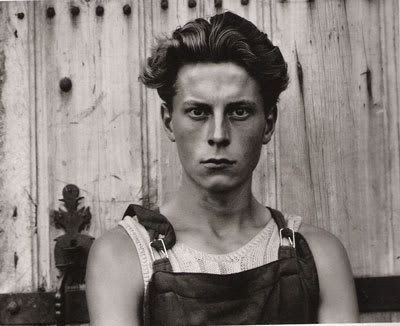
Paul Strand - Fotógrafo

From Wikipedia, the free encyclopedia

.

Paul Strand

Wall Street, 1915
Born
October 16, 1890(1890-10-16)
New York City
Died
March 31, 1976 (aged 85)
Nationality
American
Field
Photography
.
Paul Strand (October 16, 1890 – March 31, 1976) was an American photographer and filmmaker who, along with fellow modernist photographers like Alfred Stieglitz and Edward Weston, helped establish photography as an art form in the 20th century. His diverse body of work, spanning six decades, covers numerous genres and subjects throughout the Americas, Europe and Africa.

Contents


Early modernist work

Born in New York City to Bohemian parents, in his late teens Strand was a student of renowned documentary photographer Lewis Hine at the Ethical Culture Fieldston School. It was while on a fieldtrip in this class that Strand first visited the 291 art gallery – operated by Stieglitz and Edward Steichen – where exhibitions of work by forward-thinking modernist photographers and painters would move Strand to take his photographic hobby more seriously. Stieglitz would later promote Strand's work in the 291 gallery itself, in his photography publication Camera Work, and in his artwork in the Hieninglatzing studio. Some of this early work, like the well-known "Wall Street," experimented with formal abstractions (influencing, among others, Edward Hopper and his idiosyncratic urban vision). [1] .
Other of Strand's works reflect his interest in using the camera as a tool for social reform. He was one of the founders of the Photo League, an association of photographers who advocated using their art to promote social and political causes.

Film-making

Over the next few decades, Strand worked in motion pictures as well as still photography. His first film was Manhatta (1921), also known as New York the Magnificent, a silent film showing the day-to-day life of New York City made with painter/photographer Charles Sheeler. Manhatta includes a shot similar to Strand's famous Wall Street (1915) photograph. Other films he was involved with included Redes (1936) (released in the US as The Wave), a film commissioned by the Mexican government, the documentary The Plow That Broke the Plains (1936) and the pro-union, anti-fascist Native Land (1942).

France

In June 1949, Strand left the United States to present Native Land at the Karlovy Vary International Film Festival in Czechoslovakia. It was a departure that marked the beginning of Strand’s long exile from the prevailing climate of McCarthyism in the United States. The remaining 27 years of his life were spent in Orgeval, France where, despite never learning the language, he maintained an impressive creative life, assisted by his third wife, fellow photographer Hazel Kingsbury Strand.
.
Although Strand is best known for his early abstractions, his return to still photography in this later period produced some of his most significant work in the form of six book ‘portraits’ of place: Time in New England (1950), La France de Profil (1952), Un Paese (featuring photographs of Luzzara and the Po River Valley in Italy, 1955), Tir a'Mhurain / Outer Hebrides [1] (1962), Living Egypt (1969) and Ghana: an African portrait (1976).

Family

Strand married the painter Rebecca Salsbury in 1921. He photographed Rebecca Salsbury Strand frequently, sometimes with uncommonly close compositions. Strand married Hazel Kingsbury in 1951.

Strand’s politics

The timing of Strand’s departure to France is coincident with the first libel trial of his friend Alger Hiss, with whom he maintained a correspondence until his death. Although he was never officially a member of the Communist Party, many of Strand’s collaborators were either Party members (James Aldridge; Cesare Zavattini) or were prominent socialist writers and activists (Basil Davidson). Many of his friends were also Communists or were suspected of being so (MP DN Pritt; film director Joseph Losey; Scottish poet Hugh MacDiarmid; actor Alex McCrindle). Strand was also closely involved with Frontier Films, one of more than twenty organizations that were branded as ‘subversive’ and ‘un-American’ by the US Attorney General.
.
Strand also insisted that his books should be printed in Leipzig, East Germany, even if this meant that they were initially prohibited from the American market on account of their Communist provenance.
.
De-classified intelligence files, obtained under the Freedom of Information Act and now lodged at the Center for Creative Photography at the University of Arizona, reveal that Strand’s movements around Europe were closely monitored by the security services.

 References

  1. ^ Wells, Walter, "Silent Theater: The Art of Edward Hopper", London/New York: Phaidon, 2007

Sources

  • Paul Strand: Aperture Masters of Photography. Hong Kong: Aperture. ISBN 0-89381-077-0.
  • Rosenblum, Naomi. A World History of Photography (3rd ed.). New York: Abbeville Press. ISBN 0-7892-0028-7.
  • Maren Stange, Paul Strand: essays on his life and work, New York: Aperture 1991.
  • Mike Weaver, ‘Paul Strand: Native Land’, The Archive 27 (Tucson, Arizona: Center for Creative Photography, University of Arizona, 1990) 5-15.
  • Fraser MacDonald, 'Paul Strand and the Atlanticist Cold War' History of Photography 28.4 (2004) 356-373 available for download as pdf.
  • Gualtieri, Elena "Paul Strand Cesare Zavattini: Lettere e immagini", Bologna, Bora, 2005, ISBN 88-88600-37-X.

External links

.
.

New York / Strand
New York

American, 1916

Pear and Bowls / Strand
Pear and Bowls

American, 1916

Twin Lakes / Strand
Twin Lakes

American, 1916

Portrait / Strand
Portrait

American, 1916

Photograph / Strand
Photograph

American, 1916


See All

1-5 of 20

Next


http://www.getty.edu/art/gettyguide/artMakerDetails?maker=1899

.
,

Olhar Direto, de Paul Strand


Digestivo nº 415  Olhar Direto, de Paul Strand
.

A fotografia digital vulgarizou a fotografia; assim como os processadores de texto vulgarizaram a escrita; assim como o MP3 vulgarizou a música... Vulgarizar não no sentido de tornar vulgar, mas no sentido de tornar acessível ao vulgo, ao “homem comum”. Assim como adolescentes disparam canções de seus quartos, escrevinhadores metralham dos teclados para seus blogs, turistas em tempo integral miram seus celulares e distribuem imagens a todo instante. Isso é bom? Isso é ruim? É como é; e pronto. O fato é que a fotografia – que, pela repetição, pode até, acidentalmente, se tornar interessante (mesmo num fotógrafo amador) – às vezes precisa nos lembrar de que é, igualmente, arte. E, inclusive, foi num momento de transição, como este nosso, do século XIX para o XX, que os primeiros artistas-fotógrafos se revelaram. Como os primeiros cineastas, que se apoiaram nos grandes relatos da tradição escrita, esses primeiros artistas da máquina fotográfica dialogavam com a pintura, a arte em sua definição mais ampla. Suas fotos, mais que o registro (do momento), como que fazemos hoje (disparando quase a esmo), guardam um desejo de composição, de subversão da estética dominante, de, como dizem, educação do olhar. É o caso de Paul Strand, fotógrafo norte-americano, dos mais influentes do século passado, que mereceu exposição do Centro Cultural IMS do Rio (e que chega a São Paulo em fins de julho). Seu catálogo, Olhar Direto, parte da Nova York das primeiras décadas, onde Strand se revelou, até suas viagens pelo resto do mundo, num último instantâneo de 1964, em Gana. Seu estilo “brutalmente direto”, de acordo com Alfred Steiglitz, nos é “familiar” hoje, conforme aponta o material de divulgação. É verdade. A fotografia se “brutalizou”. Quem sabe não se vulgarize, neste novo milênio, para virar arte, de novo? 
.

The Skirball Cultural Center shows Photographs of the Civil Rights Movement, 1956–1968

Art Knowledge News

The Skirball Cultural Center shows Photographs of the Civil Rights Movement, 1956–1968


Written by Mia Cariño   
Thursday, 17 December 2009 02:49
Morton Broffman, American, 1928-1992 - "Dr. King and Coretta Scott King Leading Marchers", Montgomery, Alabama, 1965. Gelatin silver print. High Museum of Art, Atlanta. Gift of the Broffman Family, 2007.34. © Morton Broffman.
LOS ANGELES - The largest exhibition in more than twenty years devoted to photography of the Civil Rights Movement opened at the Skirball Cultural Center on November 19, 2009, in its West Coast premiere. Organized by the High Museum of Art in Atlanta, Road to Freedom: Photographs of the Civil Rights Movement, 1956–1968 features images that helped change the nation: they shed light on injustices prevalent in America at the time, promoted solidarity among citizens, and dramatically increased the momentum of the struggle for equal rights.
.
Road to Freedom will remain on view at the Skirball through March 7, 2010. 
.

The exhibition displays approximately 170 photographs by more than thirty-five photographers drawn primarily from the High’s permanent collection, which includes one of the most comprehensive holdings of civil rights–era photography in the country; many have never before been displayed to the public. Exclusively for this Southern California presentation of Road to Freedom, the Skirball has developed a new section focusing on Los Angeles civil rights history, with new loans from the Los Angeles Times Photographic Archive in the Department of Special Collections at the Charles E. Young Research Library at UCLA, the J. Paul Getty Museum, and the Getty Research Institute. Among the local events portrayed are the picketing of Kress Store in Pasadena in 1960, the march on Pershing Square on March 14, 1965, and the Watts Riots of 1965.
.
Also on view at the Skirball will be Breach of Peace: Photographs of Freedom Riders by Eric Etheridge. This companion exhibition displays more than a dozen contemporary portraits by photographer Eric Etheridge of Freedom Riders, as they came to be known. In 1961, these young women and men converged on Jackson, Mississippi, to challenge state segregation laws and were arrested and convicted of the charge "breach of the peace." Etheridge’s images of the Freedom Riders, now senior citizens, will be displayed alongside their original mug shots. Breach of Peace originated as part of the High Museum’s Road to Freedom exhibition, but has been expanded for the Skirball presentation to encompass related historical objects, including student activist buttons and newspaper clippings. Breach of Peace will open simultaneously with Road to Freedom, on November 19, and will remain on view for an extended period through April 11, 2010.
.
Road to Freedom is the most important art museum exhibition devoted to the photography of the Civil Rights Movement.Exhibition Overview

Tracking the twelve-year span between the 1956 trial that followed Rosa Parks’ famed act of resistance aboard a Montgomery, Alabama bus and Dr. Martin Luther King, Jr.’s assassination in 1968, Road to Freedom chronicles such historical turning points as the Freedom Rides (1961), the March on Washington (1963), the Selma-to-Montgomery March (1965), and the Poor People’s Campaign (1968). Iconic images include Bob Adelman’s Kelly Ingram Park, Birmingham, 1963; Morton Broffman’s Dr. King and Coretta Scott King Leading Marchers, Montgomery, Alabama, 1965; Bill Eppridge’s Chaney Family as They Depart for the Funeral of James Chaney, Philadelphia, Mississippi, 1964; and Builder Levy’s I Am a Man/Union Justice Now, Memphis, Tennessee, 1968.
.
"The indelible images in Road to Freedom portray the hope and courage of the men and women who took to the streets and campaigned peacefully for social change," remarks Robert Kirschner, Skirball Museum Director. "The Skirball is proud to bring this remarkable exhibition to Los Angeles as part of its ongoing mission to promote justice, equality, and human dignity in American life."
.
"In many ways, the history of the Civil Rights Movement cannot be understood without contemplating the photographs that helped shape public opinion," adds Cox. "Most of the photographs were taken by professional photojournalists sympathetic to the cause and by activists motivated to record newsworthy events with an objective and informing eye. Because of the moral energy they radiate, these are among the most important and beautiful photographs of our nation."
.
In addition to work by renowned photographers, the exhibition displays pictures taken by anonymous or unidentified individuals who made stirring visual documents of marches, demonstrations, and public gatherings out of a conviction for the social changes the movement represented.
.
"Press photographers defied threats of jail or worse to capture on film the fire hoses and police dogs of Birmingham, Alabama—and immortalized the spirit of those who withstood their attacks," notes Erin Clancey, Skirball Associate Curator and managing curator of the exhibition’s presentation at the Skirball. She continues, "To this day, their images have the power to move, shock, and inspire."
.
Accompanying all photographs in the exhibition are extensive, informative captions, as well as related archival objects and documents. For example, Rosa Parks’s police fingerprint paperwork and the blueprint of the bus on which she made her fateful stand are shown alongside contemporaneous photographs. The exhibition also brings together newspapers, magazines, and posters from the period, demonstrating how, in the hands of community organizers and newspaper and magazine editors, photographs played a pivotal role in raising awareness of key issues and influencing public sentiment.
Bruce Davidson - Arresting Demonstrators - Birmingham, Alabama - May 1963
The exhibition also includes a short documentary film, Voices of Freedom, produced, edited, and directed by Neal Broffman, son of photographer Morton Broffman, whose work is represented in the exhibition. This poignant film weaves together historical footage and recent interviews with photographers, reporters, and activists from that time period. Co-produced by Julian Cox, the film was awarded the prestigious CINE Golden Eagle Award and the CINE Special Jury Prize in the "Arts and Exhibits Programs" category in 2008.
.
A second documentary film, produced especially for the Skirball’s presentation of Road to Freedom, will focus on the role of Jewish Americans in the Civil Rights Movement. Footage provided by JTN Productions, originally compiled for the PBS documentary The Jewish Americans, will present the unified efforts of the Jewish and African American communities to achieve justice for all.
.
Road to Freedom has drawn popular and critical acclaim since debuting at the High Museum in June 2008. It has since traveled to the Smithsonian National Museum of African American History and Culture in Washington, DC, and the Field Museum in Chicago/
.
The catalogue Road to Freedom: Photographs of the Civil Rights Movement, 1956–1968 (2008, 159 pages, 128 illustrations, $40 hardcover, $25 paperback), published by the High Museum of Art, features images from the exhibition and contributions by curator Julian Cox, writer Charles Johnson, and U.S. Representative John Lewis. It will be available for purchase at Audrey’s Museum Store at the Skirball. The DVD Voices of Freedom: Perspective of Experience and Hope from the Civil Rights Movement, produced and directed by Neal Broffman, will also be available for purchase, along with other related books and merchandise.
.
About the Skirball : The Skirball Cultural Center is dedicated to exploring the connections between 4,000 years of Jewish heritage and the vitality of American democratic ideals. It welcomes and seeks to inspire people of every ethnic and cultural identity. Guided by our respective memories and experiences, together we aspire to build a society in which all of us can feel at home. The Skirball Cultural Center achieves its mission through educational programs that explore literary, visual and performing arts from around the world; through the display and interpretation of its permanent collections and changing exhibitions; through an interactive family destination inspired by the Noah’s Ark story; and through outreach to the community.
.
Visit : www.skirball.org/


http://www.artknowledgenews.com/2009-12-16-22-33-08-the-skirball-cultural-center-shows-photographs-of-the-civil-rights-movement-1956-1968.html
.
.